Blog › Salary & Remuneration
Your Salary Package Makes No Sense.
We Fixed That.
Annual with super. Daily excluding super. Hourly on a 38-hour week. Contract rate plus leave loading. Same job, three different numbers. Here's how to compare them in 30 seconds - no maths test required.
The watermelon and the strawberry
You're looking at two job offers. One says $145,000 plus super. The other says $750 per day, ABN required. A third comes in at $85 per hour on a 35-hour week.
Same type of role. Three completely different formats. You're being asked to compare a watermelon, a strawberry, and something the recruiter described as "competitive" without defining what that actually means.
This isn't your fault. Australia has one of the most complicated salary structures in the world. Between superannuation, leave loading, PAYG vs ABN, and the difference between a 35-hour week and a 38-hour week, comparing packages is genuinely hard.
Most people end up doing rough mental maths, picking the number that looks biggest, and hoping for the best. That's not a career decision. That's a guess.
No maths test. Just answers.
Enter one number. Get every conversion instantly.
We built a salary converter that does one thing well. You enter any rate - annual salary, daily rate, hourly rate - and it converts it into every other format. Including and excluding super. On both a 35-hour and 38-hour week.
No sign-up. No email capture. No data sent anywhere. It runs entirely in your browser. Type a number, pick the rate type, and the table updates instantly.
That's it. You get a complete apples-to-apples comparison in about five seconds. You can export it to PDF or Excel if you want a record for your files.
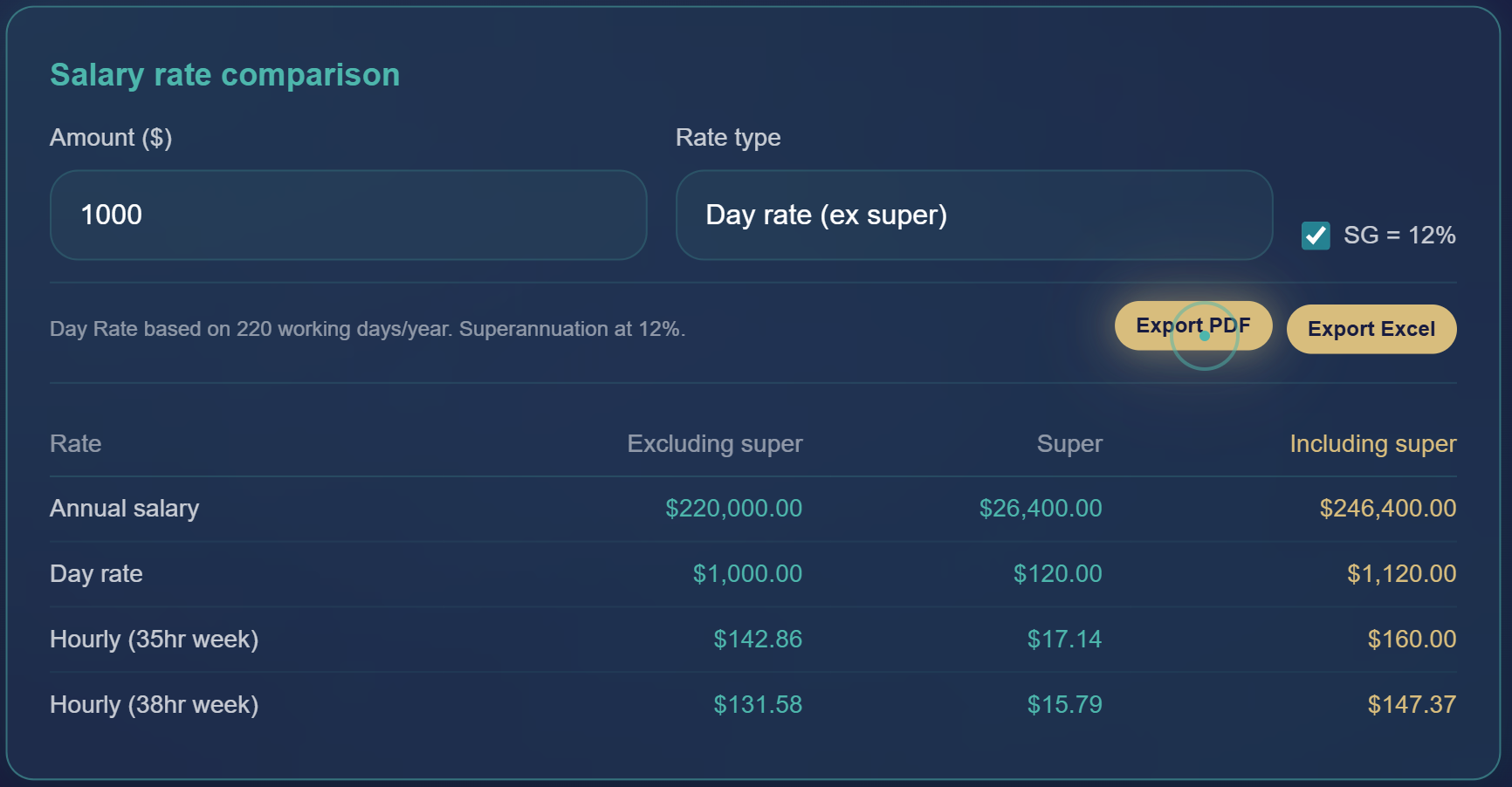
Enter one number. See every rate. → Open the Salary Converter
“This is great, I’ve already saved it to my favourites.”
Senior Talent Delivery Manager, The Network
But salary is only part of the story
The calculator gives you the numbers. Here's what the numbers can't show you.
Once you have apples-to-apples on the money, there are factors that genuinely change how a role feels day to day. Some of them are worth more than a $10K salary bump. Some are dealbreakers that no amount of money fixes.
Flexible work arrangements
Hybrid, remote, compressed weeks. A role that offers 9:30-3:30 with flex hours in the evening for parents is worth more than the dollar figure suggests.
Days in the office
Three days onsite with a 90-minute commute is a hidden cost. Factor in transport, meals, dry cleaning, and the hours you lose. That's real money and real time.
Team size and scope
Managing 15 direct reports is a fundamentally different job to being an individual contributor - even if the title and salary are similar. Know which one you want.
Extra leave
Some roles offer 5 weeks annual leave, purchased leave, or RDOs. An extra week of leave is worth roughly 2% of your salary. That adds up.
Learning and development
Conference budgets, certification funding, study leave, mentoring programs. An employer that invests in your growth is investing in your future market value.
The tech stack
Modern tools or legacy systems held together with prayer. If you care about the craft, the tooling matters. Ask what platforms they use before you accept.
EAP and wellbeing
Employee Assistance Programs, mental health days, gym memberships, wellness stipends. Benefits that support how you actually live, not just how you work.
Four-day or part-time options
Not every role needs to be five days. Some organisations genuinely support reduced hours without penalising your career progression. Ask the question.
The bottom line: Get the numbers right first - that's what the calculator is for. Then zoom out. The best career decisions aren't made on salary alone. They're made on the full picture.
How the converter works
Three inputs. One table. Every rate calculated.
Enter any amount
Annual salary, daily rate, or hourly rate. Whatever number you have been given.
Pick the rate type
Tell the calculator what the number represents. It handles the rest.
Read the table
Every conversion, including and excluding super, on both 35-hour and 38-hour weeks. Export to PDF or Excel.
Compare your packages now
Free. No sign-up. No data collection. Runs entirely in your browser.
Open the Salary ConverterFrequently asked questions
How do I compare a contract rate to a permanent salary?
Enter your contract daily rate into the Salary Converter and select "Day rate (ex super)". The table shows the equivalent annual salary, hourly rates on both 35 and 38-hour weeks, and what the total package looks like with super included. Then enter the permanent salary offer and compare the outputs side by side.
Does the calculator include superannuation?
Yes. Every conversion shows both the excluding super and including super amounts. The current Superannuation Guarantee rate of 12% is applied by default, and you can toggle it on or off depending on whether your rate already includes super.
Why is there a 35-hour and 38-hour option?
Australian standard full-time hours are 38 per week under the National Employment Standards. However, many professional roles in financial services, consulting, and corporate environments operate on a 35-hour week. The calculator shows both so you can compare accurately regardless of which standard applies to your role.
Is my data stored or shared?
No. The calculator runs entirely in your browser using JavaScript. Nothing is sent to a server. Nothing is stored. Nothing is tracked. Close the tab and the data is gone.
What about leave loading and other entitlements?
The calculator focuses on base salary and superannuation conversion. Leave loading (typically 17.5%), overtime, bonuses, and allowances vary by award, enterprise agreement, and employer. Use the calculator to get your base comparison right first, then factor in the extras specific to each offer.
Is this an AI calculator?
No - and that's deliberate. The calculator runs on coded formulas, not AI. There's no language model guessing what your salary might be. You put in $1,000 and it'll give you the same answer today, tomorrow, and next year. The maths is the maths. The results are as reliable as a spreadsheet formula, because that's essentially what they are - just faster and already built for you. AI helped with the blog you're reading right now, but the numbers? Those are code.